Subcontractor Insurance Requirements: A Sheet to Copy
What insurance GCs usually require from subcontractors, the three endorsements to check, and a fill-in requirements sheet you can send today.
By Ofir Sahar, Co-founder, COI Trackr · Updated Nov 10, 2026 · 10 min read
On this page
- Where do your subcontractor insurance requirements come from?
- What coverages should a GC require from subcontractors?
- Limits are the headline, endorsements are the story
- Do subcontractors need workers' compensation?
- Do sub-tier subcontractors need the same insurance?
- A worked example: one certificate, two answers
- How do you check every sub without a spreadsheet?
- FAQ
- The requirements sheet (copy it)
Where do your subcontractor insurance requirements come from?#
Not from a template. A GC's requirements for subs usually come from three places, and the sheet you send should match all three:
- The prime contract with the owner. Owners usually write insurance requirements into the contract, and they usually expect the GC to pass the same requirements down to every sub. If the owner wants to be an additional insured on your subs' policies, your sheet has to say so.
- Your own insurer. Your carrier may expect you to collect certificates and endorsements from subs. Ask your agent what your own policy expects.
- The law where the work happens. Workers' compensation rules are set state by state (more on this below), and licensing boards add their own rules for some trades.
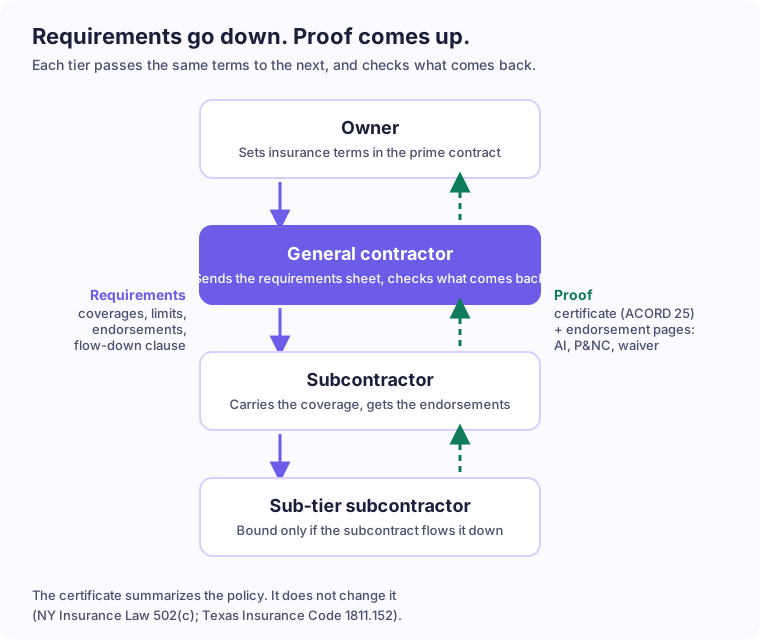
So the order is: read the owner's contract, ask your agent, then fill in the sheet. The flow below shows how it moves.
What coverages should a GC require from subcontractors?#
These are the four that usually show up on requirement sheets. For each one: what it does, and what to look for on the certificate.
| Coverage | What it is for (in one line) | What to check on the certificate |
|---|---|---|
| Commercial general liability (CGL) | Claims that the sub's work injured someone or damaged property | Each-occurrence and aggregate limits against your sheet; policy dates run through the whole job; your name in the additional insured column if you require it |
| Workers' compensation and employer's liability | Injuries to the sub's own employees | The state where the work is; policy dates; waiver of subrogation if you require it |
| Commercial auto | Vehicles the sub uses for the job | "Any auto" or the sub's owned, hired and non-owned autos, as your sheet requires |
| Umbrella or excess | Extra limits above the underlying policies | That it sits over the policies you care about, and its dates |
A certificate of insurance usually comes as an ACORD 25, the standard certificate of liability insurance form published by ACORD, the insurance industry's forms body. It summarizes the sub's policies on one page. Which brings us to the most important thing in this guide.
Limits are the headline, endorsements are the story#
People reading a certificate usually look at the limits first. The limits matter. But the protection a GC is usually counting on lives in the endorsements, and the certificate is not the endorsement.
Two state laws say it plainly:
- New York Insurance Law § 502(c): a certificate of insurance "shall not amend, extend, or alter the coverage provided by the insurance policy" it refers to, and it can't give anyone rights beyond those the policy provides (NY Senate, Insurance Law § 502; readable copy of § 502).
- Texas Insurance Code § 1811.152: a certificate "is not a policy of insurance" and does not change the coverage of the policy it refers to (Texas Insurance Code ch. 1811; readable copy of § 1811.152).
In practice: a "Y" in the additional insured column of a certificate tells you what the agent says the policy does. If the policy itself was never endorsed, the certificate can't make it so. That is why careful GCs ask for the endorsements themselves, not just the certificate. Here are the three that matter most:
| Endorsement | What it does | Why a GC asks for it |
|---|---|---|
| Additional insured (AI) | Adds a person or company to a policy the sub bought (Next Insurance glossary) | So the GC (and often the owner) can claim under the sub's liability policy for the sub's work |
| Primary and noncontributory (P&NC) | Sets the order: the sub's policy answers a claim first, and its insurer doesn't ask the GC's insurer to help pay, subject to the endorsement's terms (IRMI, Craig Stanovich) | Keeps a loss caused by the sub's work off the GC's own policy first |
| Waiver of subrogation | The sub's insurer gives up its right to recover what it paid from others after paying a claim (Next Insurance glossary) | So the sub's insurer doesn't pay a claim and then come after the GC |
These are three separate things. One doesn't imply another: an additional insured endorsement doesn't by itself make coverage primary and noncontributory, and a waiver of subrogation doesn't make anyone an additional insured. Your sheet should name each one you want, and on which policies. Which endorsement forms fit your contract is a question for your insurance agent or attorney.
The rule of thumb to keep: Limits are the headline, endorsements are the story. Read the endorsements as carefully as the limits.
Do subcontractors need workers' compensation?#
It depends on the state, and the differences are big. Four examples, all from the state's own pages:
- California: "All California employers must provide workers' compensation benefits to their employees," under Labor Code § 3700 (CA Division of Workers' Compensation FAQ).
- California, some trades even with no employees: the Contractors State License Board says C-8 concrete, C-20 HVAC, C-22 asbestos abatement, C-39 roofing and C-61/D-49 tree service contractors must carry workers' comp "whether or not they have employees," under Business and Professions Code § 7125 (CSLB).
- Texas: most private employers may choose whether to carry workers' comp; the state says it "is not required in most cases" (Texas Department of Insurance).
- New York: in hazardous employment, if a sub hasn't secured workers' comp, the contractor above it can be liable to pay compensation to the sub's injured employee (NY Workers' Compensation Law § 56; readable copy).
The New York rule is the one to remember: in some states, a sub with no workers' comp can become the GC's problem. So even where the state lets a sub go without it, many GCs require it anyway, or require proof of a state exemption. Whether a 1099 worker counts as an employee under your state's rules is a legal question: check with your insurance agent or attorney.
Do sub-tier subcontractors need the same insurance?#
Your requirements only protect you if they reach everyone on site. When your sub hires its own sub, the second-tier sub is not bound by your sheet unless your subcontract says your sub must pass the same requirements down.
Add a flow-down sentence to the subcontract and to your sheet (it is in the template below), and ask each sub for its sub-tier subs' certificates too. In the flow diagram above, that is the bottom row: requirements go down every tier, and proof comes back up every tier.
A worked example: one certificate, two answers#
Made-up names, typical situation.
Riverside Builders (a made-up GC) requires general liability, workers' comp and auto from every sub, with Riverside and the owner named as additional insureds, primary and noncontributory, plus a waiver of subrogation on GL and workers' comp.
Northline Drywall (a made-up sub) sends an ACORD 25. The limits match the sheet. The dates span the job. The additional insured column shows "Y" on the general liability line, and the description box names Riverside and the owner.
Answer one (limits only): compliant. File it.
Answer two (limits and endorsements): not yet. Nothing attached shows the additional insured endorsement or the primary and noncontributory wording, and the waiver of subrogation column is blank on the workers' comp line. Riverside asks Northline's agent for the endorsement pages, and for the waiver to be added if the policy allows it.
Same certificate, two answers. The difference is whether anyone read past the headline.
How do you check every sub without a spreadsheet?#
With five subs, a spreadsheet and a calendar reminder can work. With fifty, each certificate expires on its own date, each sub has its own agent, and the endorsement check above has to happen every time a policy renews.
COI Trackr (coitrackr.com) does that part: subs upload their certificates from a free account, it reads each one, checks it against your requirements, shows what is missing (in the demo, with sample data, a line such as "Not met: Additional Insured"), and reminds subs before coverage lapses. Reading is automated and can be wrong or incomplete, so every result can be reviewed. It is free for up to 10 subcontractors, with no credit card. See it with sample data first: coitrackr.com/demo.
Track these automatically
FAQ#
Do 1099 subcontractors need workers' comp?
It depends on the state and on whether the worker counts as an employee under that state's rules. California requires every employer to carry it, Texas makes it optional for most private employers, and New York can make the contractor above an uninsured sub liable (sources above). Check with your insurance agent or attorney.
What if a sub has no insurance at all?
Then they don't meet your sheet. In some states the GC can end up liable for an uninsured sub's injured workers (New York's § 56 is one example), and the GC's own insurer may treat uninsured subs differently. Ask your agent before letting them on site.
Is a certificate of insurance proof of coverage?
It is a summary of coverage as of the day it was issued. New York and Texas law both say it can't change or add to the policy (sources above). For additional insured, primary and noncontributory and waiver of subrogation, ask for the endorsements.
How often should I re-check a sub's insurance?
At least whenever a policy renews or the sub starts a new job with you, since each policy has its own end date and a renewed policy can carry different endorsements.
What limits should I require?
That comes from your prime contract and your own insurer, so we leave it blank on purpose. Ask your insurance agent.
The requirements sheet (copy it)#
Fill the brackets from your prime contract and your agent's advice. Delete lines that don't apply. This is a starting point, not legal or insurance advice: check with your insurance agent or attorney before you send it.
The requirements sheet
Your company name: Subcontractor insurance requirements
Project: project name and address · Owner: owner legal name · Date: date
Before starting work, and at every renewal, each subcontractor provides a certificate of insurance and the endorsements listed below.
1. Coverages and limits
- Commercial general liability: each occurrence $____ / general aggregate $____ / products-completed operations aggregate $____
- Workers' compensation: statutory limits for state; employer's liability $____ each accident / $____ disease each employee / $____ disease policy limit. If exempt: a copy of the state exemption.
- Commercial auto: $____ combined single limit, for any auto / owned, hired and non-owned autos
- Umbrella or excess: $____ each occurrence / aggregate, over CGL, auto, employer's liability
- Other: professional liability / pollution / installation floater / other, if your contract requires it
2. Endorsements (attach the endorsement pages, not only the certificate)
- Additional insured on CGL and auto, and umbrella: your company, owner, others named in the prime contract, for ongoing and completed operations
- Primary and noncontributory on CGL and umbrella, in favor of the additional insureds
- Waiver of subrogation on CGL, auto, workers' comp, umbrella, in favor of your company, owner
- Notice of cancellation to your company, if the policy provides for it
3. The certificate
- Certificate holder: your company legal name and address
- Description of operations names the project and the additional insureds
- Policy dates run through the full contract period, including completed operations period, if required
4. Sub-tier subcontractors (flow-down)
"Subcontractor shall require each of its sub-subcontractors to carry the same insurance and endorsements required by this sheet, naming the same additional insureds, and shall provide their certificates and endorsements to your company before they start work."
5. Where to send
Send certificates and endorsements to email or upload link before start date. Work does not start until they are received and accepted.
Sources (checked Nov 9, 2026)
- nysenate.gov/legislation/laws/ISC/502
- newyork.public.law/laws/n.y._insurance_law_section_502
- newyork.public.law/laws/n.y._workers'_compensation_law_section_56
- statutes.capitol.texas.gov/Docs/IN/htm/IN.1811.htm
- texas.public.law/statutes/tex._ins._code_section_1811.152
- dir.ca.gov/dwc/faqs.html
- tdi.texas.gov/wc/employer/index.html
- nysenate.gov/legislation/laws/WKC/56
- cslb.ca.gov/contractors/maintain_license/workers_compensation.aspx
- nextinsurance.com/glossary/additional-insured/
- nextinsurance.com/glossary/waiver-of-subrogation/
- irmi.com/articles/expert-commentary/primary-and-noncontributory
- acord.org/forms-pages/acord-forms